


General information for employers in Great Britain, not legal advice. If you are unsure, take advice from a solicitor or a qualified health and safety adviser.
Shops, pubs, hotels and warehouses are taking on seasonal and agency staff to get through the Christmas peak. Many of those colleagues can be on a till, behind a bar or on a loading bay within a day or two. The question is whether they could raise a concern if something went wrong on that first late shift.
On 9th November 2026, the shopworkers' union Usdaw published interim results from its 2026 survey, based on 2,233 responses from retail workers. In the last twelve months, 69% had experienced verbal abuse, 45% had been threatened by a customer and 12% had been assaulted. These are interim figures. Usdaw says the final results will be published early next year.
Usdaw's general secretary, Joanne Thomas, also pointed to the run-up to Christmas, "when the number of incidents increases as shops get busy and customers become frustrated." The same pressure shows up in hospitality, and in warehouses and distribution, where temporary staff are brought in to handle more orders and deliveries, often on a site they do not know well.
A person who started this week can serve customers, pick orders or work a bar as soon as they have been shown the basics. They are often the least likely people on the floor to have a login, or a supervisor with time to sit down at the start of a late shift. That is not a survey finding; it is a common pattern in peak staffing.
Health and safety duties in Great Britain are not limited to permanent staff.
Under section 2 of the Health and Safety at Work etc. Act 1974, employers must provide the information, instruction, training and supervision necessary to ensure, so far as is reasonably practicable, the health and safety at work of their employees. That includes people you employ directly for the peak on short or fixed-term contracts, not only those on permanent contracts. For people working on your site who are not your employees, such as many agency workers, section 3 requires you to run your business so that, so far as is reasonably practicable, they are not exposed to risks to their health or safety.
For agency workers, HSE's guidance is that, in practice, day-to-day responsibility for health and safety during the assignment lies with the business where the work is done, because it directs the work and may also control the premises. The agency or employment business keeps its own duties, and HSE's advice is to agree who does what and never assume someone else will take responsibility. Before a worker is placed, HSE says the supplier should obtain clear information from that business, including the risks and controls in place and clear guidance on how to raise health and safety concerns in the workplace, and give it to the worker before work starts.
The Management of Health and Safety at Work Regulations 1999 add specific information duties. If you take someone on under a fixed-term contract of employment, you must tell them, before they start, about any special occupational qualifications or skills they need to work safely and any health surveillance required. If a worker comes from an employment business, you must give the worker information on those qualifications or skills and any health surveillance, and give the employment business information on those qualifications or skills and on the features of the job likely to affect health and safety, which it must pass on to the worker. Anyone working on your site who is not your employee must also be given appropriate instructions and comprehensible information about the risks to their health and safety from your work.
None of that is special to Christmas. These are existing duties, tested when the site is at its busiest and a large part of the team is new.
Many operators already have an incident, HR or case system, and a policy that tells people how to use it. That is necessary. It is not always sufficient in December.
A process that lives behind a staff login, or that only works if a supervisor has time to walk someone through it, is a process a Christmas temp may never use. The test is not whether a process exists. It is whether a person who started this week, on an unfamiliar site, could report an injury, a near miss or abuse before the end of the shift, and whether anyone across the group would see it.
If they cannot, the system you already have will keep recording only what permanent staff, or the people who already know how to log in, put into it.
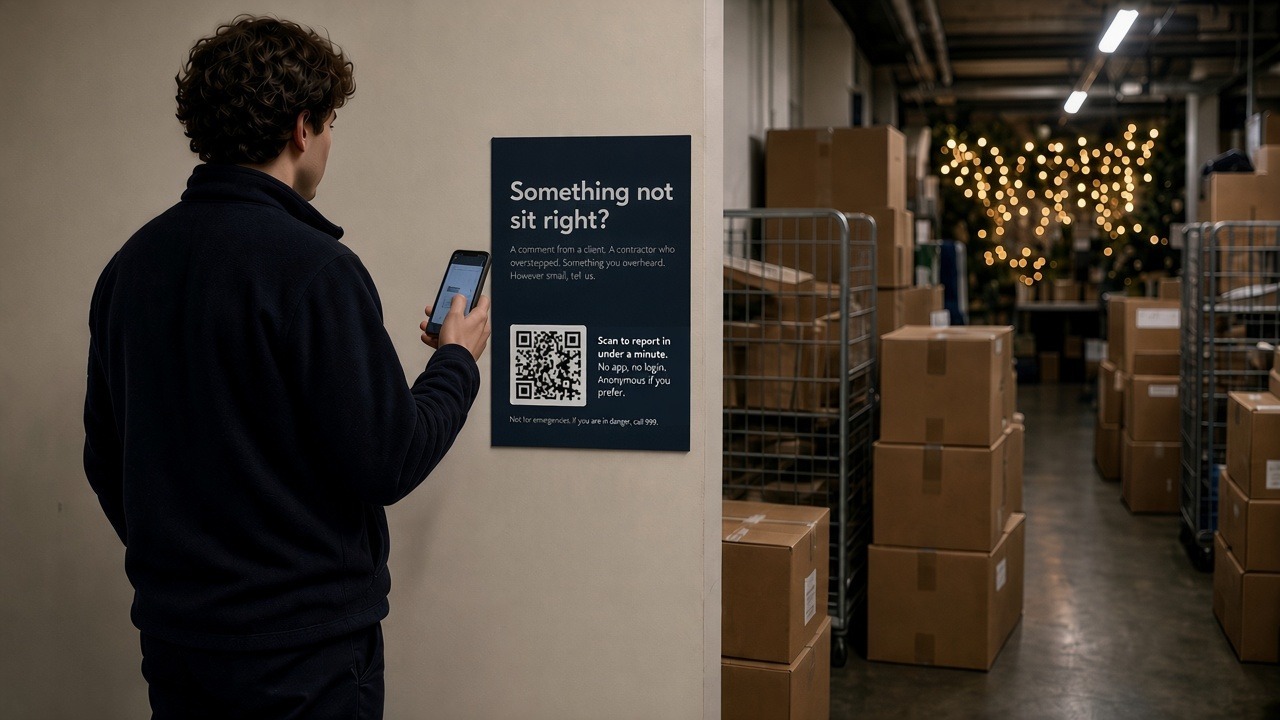
We run Continual, a UK reporting platform. Colleagues can report by scanning a QR code, with no login, and anonymously if they choose. AI analyses each report to help your team spot patterns, and your team decides what to do. It sits alongside the incident, HR or case-management systems you already have; it does not replace them, or your risk assessments, induction or RIDDOR reporting. It is designed as a light addition to what you already have.
At one busy site, ask how a seasonal or agency colleague on tonight's shift would report an injury, a near miss or abuse. Were they told that in induction, or is it assumed? Do they need a login? Who sees the report if the usual manager is already onto the next delivery?
Reporting internally does not replace any report you must make to HSE under RIDDOR. For agency workers, who makes that report depends on who employs them, so agree it with your supplier.
If the honest answer is that they would tell a colleague and hope it goes further, the process you already have is not reaching the people you have just brought in to get through Christmas.
Injury and abuse reports often include health or other sensitive personal information, so check your privacy notice and retention rules cover them.
If you'd like to see how it works, get in touch.
To experience the power of community vigilance across your stores and sites, schedule a personalised demo now.
We are also available on the details below.


