


Walk through any busy shopping centre and hundreds, sometimes thousands, of people are observing what is happening around them.
A shop assistant notices someone behaving unusually. A customer sees an item being concealed. A café worker recognises the same group returning several days in a row. A security guard sees one part of an incident, while a neighbouring retailer sees another.
Individually, these are tiny pieces of information.
Collectively, they can become intelligence.
And there is a fascinating body of behavioural research behind the idea that encouraging people to contribute these observations could help create safer, more resilient communities.
One of the most relevant concepts is collective efficacy.
Landmark research published in Science defined collective efficacy as a combination of social cohesion and people's willingness to intervene on behalf of the common good. Studying neighbourhoods in Chicago, researchers found that greater collective efficacy was associated with lower levels of violence.
The important idea is that communities aren't protected solely by formal policing or security. The behaviour of the people within them matters too.
For a town centre, that doesn't mean asking shoppers to confront suspected shoplifters - something that could be unsafe and should be left to trained staff.
It means giving people a safe, simple and legitimate way to contribute.
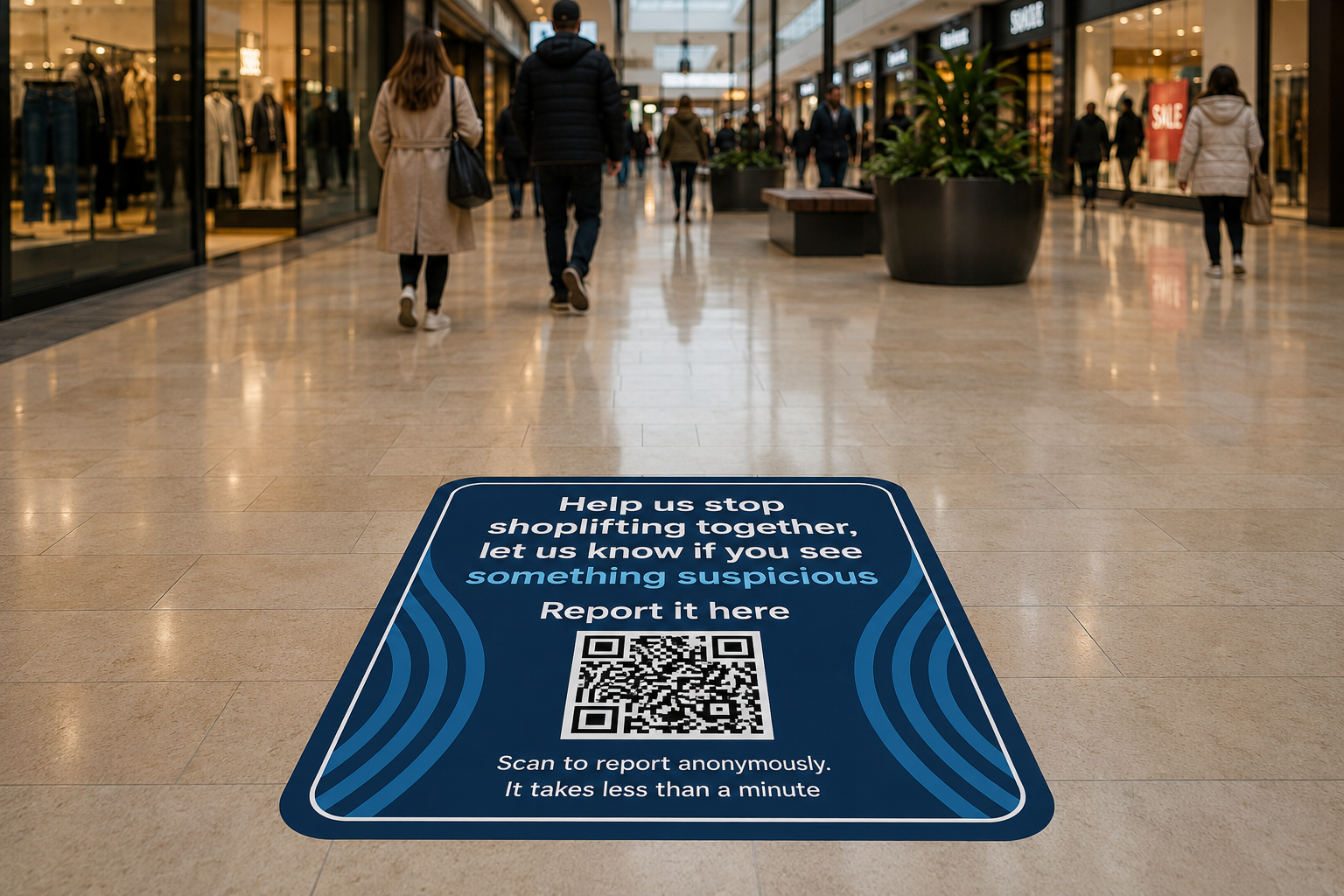
A message on the floor saying:
“Help us stop shoplifting together. Let us know if you see something suspicious.”
does something psychologically interesting.
It changes the individual's perceived role from passive observer to potential contributor.
Bystander research has long demonstrated that witnessing something doesn't automatically result in reporting it.
People hesitate.
Was that actually suspicious?
Is it any of my business?
Does somebody else already know?
Who would I even tell?
I don't want to get involved.
Experiments specifically examining bystander responses to shoplifting found that the behaviour of other bystanders had a particularly strong effect on reporting behaviour. More recent research continues to examine how people decide whether, and how, to intervene when witnessing crime.
This creates an important design challenge.
If we want community participation, we need to remove as much ambiguity, friction and perceived personal risk as possible.
A visible invitation to report establishes a social norm:
We care about this. Reporting is welcomed. Other people are helping too. And there is an easy way for you to contribute.
Scan a QR code. Share what you saw. Do it anonymously where appropriate. Get on with your day.
That's very different from expecting someone to find a security guard, challenge an individual themselves or search online for the correct reporting process.
There is potentially another side to collective vigilance: the person considering committing an offence.
Crime isn't always an entirely impulsive act. Opportunity matters.
A potential offender can consciously or unconsciously assess the environment around them:
Am I being watched?
Is anyone paying attention?
How likely am I to be noticed?
How likely is someone to act?
Research involving interviews with UK shoplifters found that security measures including guards, retail staff, CCTV and signage could deter at least some offenders, although importantly, no intervention deterred everyone.
That qualification matters.
A community-reporting system isn't a magic forcefield around a shopping centre.
But imagine the change in perceived environment when prominent signage communicates:
The people around you aren't simply shoppers. They're part of the area's eyes and ears - and they have an immediate way to report what they see.
The perceived number of potential “guardians” has suddenly increased enormously.
There is an even bigger opportunity.
Someone reporting:
“I saw suspicious behaviour outside this shop at 4pm”
may or may not provide enough information to act upon.
But imagine combining that observation with dozens of others.
Suddenly:
17 observations have been made in the same location.
Most occur between 3pm and 6pm.
Several describe similar behaviour.
Four neighbouring businesses have reported incidents.
The pattern has intensified over the past three weeks.
Now we aren't simply talking about reporting.
We're talking about collective intelligence.
This is where platforms such as Continual can play an interesting role. AI can help turn large numbers of small, unstructured human observations into something that can be understood — identifying common themes, locations, timings and emerging patterns that individual businesses or security teams could easily miss.
The human provides the observation.
Technology helps connect the dots.
There is also a softer benefit that shouldn't be underestimated.
Crime and antisocial behaviour can create a sense of helplessness.
People see things happening around them but don't necessarily believe they can do anything meaningful about it.
Creating a visible mechanism for participation changes that relationship.
Instead of:
“Someone should do something about this.”
we create:
“I can contribute to doing something about this.”
That sense of agency is fundamental to collective efficacy.
And when BIDs, shopping centres and retailers close the loop, showing that information has resulted in additional patrols, changed security arrangements, police engagement or another intervention, participation becomes visibly worthwhile.
You saw it.
You told us.
Together, we acted.
Technology will continue to play an important role in tackling retail crime. CCTV, analytics and AI all have their place.
But perhaps one of the most powerful sensors available to a town centre already exists.
People.
Employees. Shoppers. Taxi drivers. Cleaners. Security teams. Residents. Visitors.
Each sees a tiny fragment of what is happening.
The opportunity is to make it effortless for them to contribute those fragments, and intelligent enough behind the scenes to connect them.
Because one observation might identify an incident.
Hundreds of observations can tell us a story.
And if we can understand that story early enough, we have a much better chance of changing how it ends.
To experience the power of community vigilance across your stores and sites, schedule a personalised demo now.
We are also available on the details below.


