


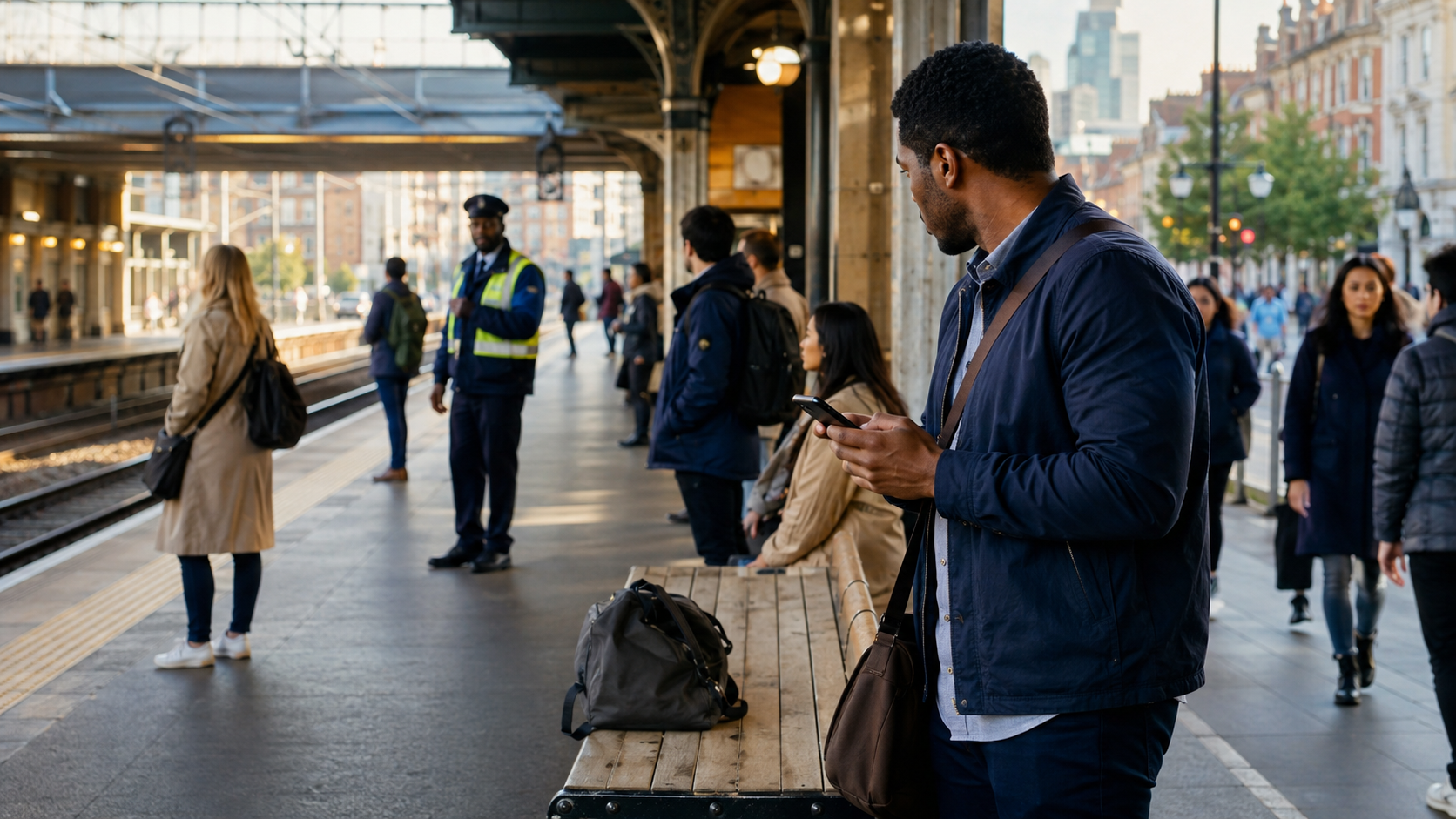
You are standing on a crowded platform. A bag has been left beneath a bench. Perhaps its owner is buying coffee. Perhaps someone else has already noticed it. Perhaps it is none of your business.
Then comes the familiar announcement: “See it. Say it. Sorted.”
Its achievement is not simply that it tells passengers what to do. It interrupts a much older piece of human psychology: the tendency to hesitate when responsibility is shared among a crowd. By turning an uncertain moment into a three-step script, the campaign gives people permission to act, and reassures them that the next step belongs to someone equipped to take it.
That is why the campaign offers a useful lesson far beyond the railway. A thriving high street, visitor attraction or sports venue also depends on the people who use it noticing what is happening, knowing how to help and trusting that their contribution will lead somewhere. This is the thinking Continual applies to place-based engagement: make participation visible, simple and consequential, so that a collection of individuals begins to behave more like a community.
The campaign was launched nationally in 2016 by the Department for Transport, working with the Home Office and police forces. Its purpose was practical: encourage passengers to report unusual items or behaviour. The British Transport Police (BTP) supports that promise with a discreet channel, texting 61016, for non-emergency incidents on the railway.
But its wording does important psychological work.
“See it” legitimises the passenger’s perception. You do not need to be a security professional to notice that something does not feel right.
“Say it” supplies a clear, manageable action. The individual is not being asked to investigate, confront or diagnose, only to pass on what they observed.
“Sorted” closes the loop. It signals that responsibility transfers to trained people who can assess the situation. That matters because people are more likely to take protective action when they believe both that the response will be effective and that they themselves are capable of carrying it out. The Protective Action Decision Model, developed from research on responses to hazards and warnings, identifies precisely these kinds of judgements, about threat, protective action and situational barriers, as central to behaviour.
The slogan also works as a compact “implementation intention”: it connects a cue to an action. If I see something unusual, I say something. In a pressured or ambiguous situation, that ready-made rule reduces cognitive effort.
Security traditionally looks like something delivered to the public: officers, barriers, cameras and control rooms. “See It. Say It. Sorted.” reframes it as something delivered with the public.
The scale of participation suggests that the message changed behaviour. BTP’s 2019/20 annual reporting recorded 131,792 texts to the campaign’s reporting service in that year alone. When the campaign was refreshed in 2025, the government said annual public reports had risen from roughly 30,000 before 2015 to more than 255,000. Reporting volume is not the same thing as crimes prevented, and it should not be presented as such. It is, however, strong evidence that many more people learned and used the route into the security system.
The design of that route matters. BTP describes 61016 as a direct and discreet way for passengers and rail staff to report non-emergency crime. A text message lowers the social risk of speaking up in public, avoids a confrontation and works in situations where making a call would feel conspicuous. In behavioural terms, the campaign reduces friction at exactly the point where hesitation can become inaction.
There is also a wider social effect. Every time the message plays, it states a norm: people here pay attention; people here are allowed to help; reports will be taken seriously. The individual is no longer an isolated observer but part of a shared protective network.
This resembles what social scientists call collective efficacy - social cohesion combined with a willingness to intervene for the common good. In their landmark study of 8,782 residents across 343 Chicago neighbourhoods, Robert Sampson, Stephen Raudenbush and Felton Earls found that higher collective efficacy was associated with lower levels of violence, after accounting for individual and neighbourhood factors. The study does not prove that a transport slogan creates safer communities. It does show why the sense that “people like us can act together here” is so important. Read the study abstract.
“Sorted” is the campaign’s most ambitious word. It is a promise of institutional responsiveness.
People will continue to participate only if they believe the system behind the invitation is listening. A reporting channel that feels like a void can quickly turn empowerment into cynicism. Conversely, acknowledgement, visible action and honest updates reinforce both personal efficacy (“my action mattered”) and collective efficacy (“we can improve this place together”).
There is a caution here too. Repetition makes a message memorable, but excessive repetition can make it background noise. Research on security warnings shows that repeated exposure can produce habituation, a declining response to familiar prompts. and that even non-security notifications can reduce attention to later security warnings. The campaign’s longevity therefore owes as much to the simplicity and availability of its reporting route as to the frequency of its announcements. Familiarity should create readiness, not fatigue.
For any organisation borrowing these principles, the lesson is clear: vary the context, keep prompts relevant, make the action effortless and show that contributions produce a response.
Imagine a busy high street on a Saturday afternoon. Shop teams, residents, visitors, cleaners, security staff and the local authority all see different fragments of the same place. One person notices a damaged light. Another sees a vulnerable visitor who may need help. A trader spots repeated antisocial behaviour near a side street. Each observation is useful, but only if there is a trusted way to turn it into shared awareness and appropriate action.
Continual uses the same behavioural architecture:
At a sports venue, this could mean supporters discreetly flagging harassment, congestion or a welfare concern and receiving immediate guidance. At a visitor attraction, it could help guests report a hazard or request assistance without searching for a staff member. On a high street, it could connect dozens of small observations into a clearer, shared picture of what the area needs.
The purpose is not to make people anxious or encourage indiscriminate suspicion. Good community engagement distinguishes between emergencies, security concerns, service issues and positive ideas; gives each a proportionate pathway; protects privacy; and makes clear that trained teams retain responsibility for assessment and response.
“See It. Say It. Sorted.” endured because it gives the public a role without giving them the burden of enforcement. It converts attention into an achievable action and individual action into institutional response.
The deeper lesson is that community security is partly an infrastructure problem and partly a belief problem. People need to believe that they are entitled to contribute, that doing so is easy, that others will play their part and that the system will respond.
When those conditions are designed into a location, engagement stops being an occasional consultation exercise. It becomes a continual habit: notice, contribute, respond, improve. That is how a passenger becomes a participant - and how a place becomes a community that is better able to look after itself.
To experience the power of community vigilance across your stores and sites, schedule a personalised demo now.
We are also available on the details below.


